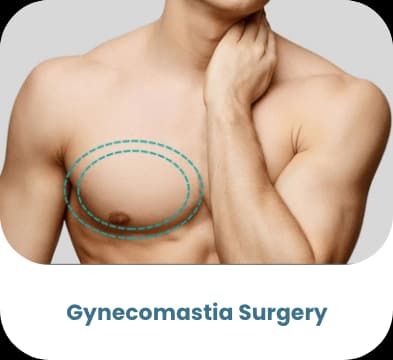
Gynecomastia surgery (male chest reduction) treats enlarged male breasts by removing excess glandular tissue and fat to create a flatter, firmer, more masculine chest contour. It is a common, effective procedure for men whose chest fullness has not responded to weight loss or exercise.
Gynecomastia surgery combines liposuction to remove excess fat with direct excision of glandular breast tissue through a small incision, usually at the edge of the areola. The chest is then contoured for a natural, masculine shape. The right balance of liposuction and excision depends on whether the fullness is mostly fat, gland, or both.
Gynecomastia surgery is tailored to the type of fullness:
Assessment — the cause is reviewed and the balance of fat and glandular tissue assessed.
Liposuction — excess fat is suctioned through tiny incisions to refine the contour.
Glandular excision — firm breast tissue is removed directly, usually via a small areolar incision.
Recovery — a compression vest supports healing and helps the skin retract.
You may be a suitable candidate if you:
Have enlarged male breasts that bother you
Have not improved with weight loss or exercise
Are at a stable weight and in good general health
Are a non-smoker, or can stop around surgery
Do not have an untreated, reversible cause (e.g., certain medications or substances)
Days 1–3Swelling, bruising; compression vest worn; rest
Week 1Most return to desk work; light walking
Weeks 4–6Compression vest as advised; gradual return to exercise
Months 2–6Swelling settles; final flatter contour appears
Results are long-lasting when weight is stable and any drug-related cause is avoided; significant weight gain or steroid use can affect the chest again.
Gynecomastia surgery is a common, well-established procedure, but as with any surgery there are risks: swelling, bruising, temporary numbness, contour irregularities or asymmetry, small scars, fluid collection (seroma), and the small risks of anaesthesia. If significant skin needs removing, scars are larger. Wearing the compression vest and following aftercare improve the contour and recovery.
Ministry-authorised health tourism — operating under the Republic of Türkiye Ministry of Health Health Tourism Authorization Certificate and a member of Health Türkiye.
Experienced multidisciplinary team — strong academic background and a high volume of successful procedures.
Accredited partner hospital — treatment in a fully equipped, modern clinical setting.
All-inclusive care — free online consultation, VIP airport transfers, accommodation, interpreter support and follow-up.